Cart (0)
No products in the cart.
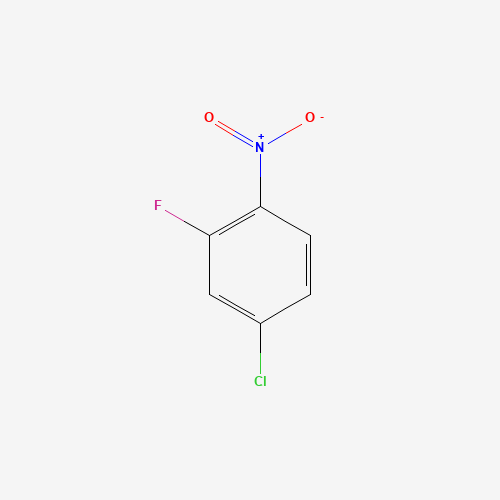
Purchase CAS:700-37-8 | 4-Chloro-2-fluoronitrobenzene,view related peer-reviewed papers,technical documents,similar products,MSDS & more.4-Chloro-2-fluoro-1-nitrobenzene (CFNB) is a highly reactive and versatile chemical compound with a wide range of applications in the fields of chemistry, biochemistry, and medicine. CFNB is a colorless, odorless solid with a molecular formula of C6H3ClFNO2. It is a halogenated nitrobenzene derivati...

4-Chloro-2-fluoro-1-nitrobenzene (CFNB) is a highly reactive and versatile chemical compound with a wide range of applications in the fields of chemistry, biochemistry, and medicine. CFNB is a colorless, odorless solid with a molecular formula of C6H3ClFNO2. It is a halogenated nitrobenzene derivative, which makes it particularly useful in the synthesis of various drugs and other compounds. CFNB has been used in the synthesis of a variety of pharmaceuticals, including antifungal agents, antibiotics, and antiparasitic agents. It has also been used in the synthesis of a number of industrial chemicals, including dyes and fragrances.
4-Chloro-2-fluoro-1-nitrobenzene has been used in the microwave-mediated reduction of nitroaromatics. This process includes the reduction of 4-fluoronitrobenzene to 4-fluoroaniline and a mixture of 3-chloro-4-fluoroaniline and 3-chloro-4-ethoxyaniline from 2-chloro-1-fluoro-4-nitrobenzene. The solvent choice impacts the SNAr/reduction process, with t-BuOH being an inert solvent choice for such reactions (Spencer et al., 2008).
Studies have investigated the hydrogenation of 3-chloro-4-fluoro nitrobenzene to 3-chloro-4-fluoro aniline using a Pt-Cu-S/C catalyst. The catalyst showed high activity and selectivity under specific conditions, with a yield of 98% and purity over 99.5% (Liang Wen-xia, 2014).
The synthesis of 1-fluoro-2,5-dimethoxy-4-nitrobenzene from commercial 2-fluoro-1,4-dimethoxybenzene using nitric acid involves 4-chloro-2-fluoro-1-nitrobenzene as an intermediate. The structure of the synthesized compound was confirmed by X-ray crystallography and characterized by various spectroscopic methods (Sweeney et al., 2018).
4-Chloro-2-fluoro-1-nitrobenzene has been studied in the context of aromatic nucleophilic substitution. The ortho:para ratios were measured for reactions with various anions, and the results were discussed in terms of steric exclusion and solvation effects in the transition states (Bamkole et al., 1973).
| Product Name: | 4-Chloro-2-fluoronitrobenzene |
| Synonyms: | 4-CHLORO-2-FLUORONITROBENZENE;4-CHLORO-2-FLUORO-1-NITROBENZENE;2-FLUORO-4-CHLORONITROBENZENE;1-CHLORO-3-FLUORO-4-NITROBENZENE;Chlorofluoronitrobenzene;4-Chlor-2-fluor-1-nitrobenzol;4-Chloro-2-fluoronitrobenzenen;2-fluoro-4-chloroitrobenzene |
| CAS: | 700-37-8 |
| MF: | C6H3ClFNO2 |
| MW: | 175.54 |
| EINECS: | 211-842-5 |
| Product Categories: | Fluorine series |
| Mol File: | 700-37-8.mol |
| 4-Chloro-2-fluoronitrobenzene Chemical Properties |
| Melting point | 48°C |
| Boiling point | 241.8±20.0 °C(Predicted) |
| density | 1.494±0.06 g/cm3(Predicted) |
| Fp | >110℃ |
| storage temp. | Sealed in dry,Room Temperature |
| form | powder to crystal |
| color | White to Light yellow to Green |
| CAS DataBase Reference | 700-37-8(CAS DataBase Reference) |
|
|
|
|
|
|